


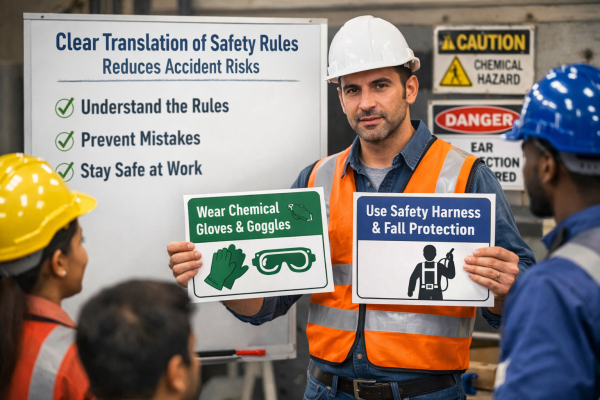
In workplaces, safety rules are often perceived as formal documents. However, their real impact only emerges when employees fully understand them and are able to apply them in their daily tasks. Especially in environments where workers speak different languages, the quality of translation directly affects the level of accident risk.
For example, imagine a worker in a manufacturing setting receiving the following instruction: “Use appropriate protective equipment when handling chemicals.” This sentence may seem correctly translated, but the phrase “appropriate protective equipment” is not specific enough. The worker may not clearly understand which equipment is required. If the instruction is translated more clearly as “When handling chemicals, wear chemical-resistant gloves and protective goggles,” the likelihood of error is significantly reduced.
Let’s consider another example. The phrase “Work at height requires fall protection,” commonly used in construction, is sometimes translated simply as “Protection is required when working at height.” While this translation is technically correct, it is not practical. The worker may not understand what type of protection is needed. A more effective version would be: “When working at height, you must wear a safety harness and use a fall protection system.” This kind of clarity directly influences worker behavior.
The importance of clear translation is not limited to written rules; it also plays a crucial role in training processes. Imagine a company conducting safety training where the materials are translated into complex, overly technical language. Employees attend the training but do not fully understand what is being explained. As a result, they have only “heard” the rules but cannot apply them. When the same training is delivered in simpler, more accessible language, employees are better able to understand how to act in real situations.
For instance, instead of saying “Perform a technical inspection before operating the equipment,” a more effective translation would be: “Before starting the equipment, check whether the cables are damaged and ensure all parts are in place.” This makes it clear to the worker exactly what needs to be checked.
Accurate translation of safety rules also reduces legal risks. In many countries, employers are obligated to present safety information to employees in a clear and understandable way. Translation errors can lead to serious legal consequences.
These risks may include, but are not limited to, fines, legal disputes, and damage to the company’s reputation.
Clear and precise translation also strengthens employee responsibility. When workers fully understand the rules, they are more likely to take responsibility for their own safety. In contrast, unclear or confusing instructions weaken this sense of responsibility.
In practical terms, this means that employees can recognize risks more quickly, reduce the likelihood of accidents in advance, and avoid unsafe behavior.
In conclusion, the clear translation of safety rules plays a crucial role in reducing workplace risks. Clear and specific language guides employee behavior, prevents mistakes, and creates a safer working environment. This approach not only improves safety standards but also helps employees feel more secure in their workplace.
If you want to ensure that safety rules in your company are communicated clearly and effectively, it’s time to seek professional support. At CETA Translations, we provide accurate, industry-specific, and easy-to-understand translations of technical and safety documentation. Our goal is not just to translate words, but to ensure that the message is clearly understood by every employee. Contact us today and take a step toward a safer workplace!